Thermal springs.
Mineral-bearing waters emerge above the plain and move down the hillside.
LANDSCAPE KEY Spring water
01 / The landscape
A flowing spring leaves a solid trace.
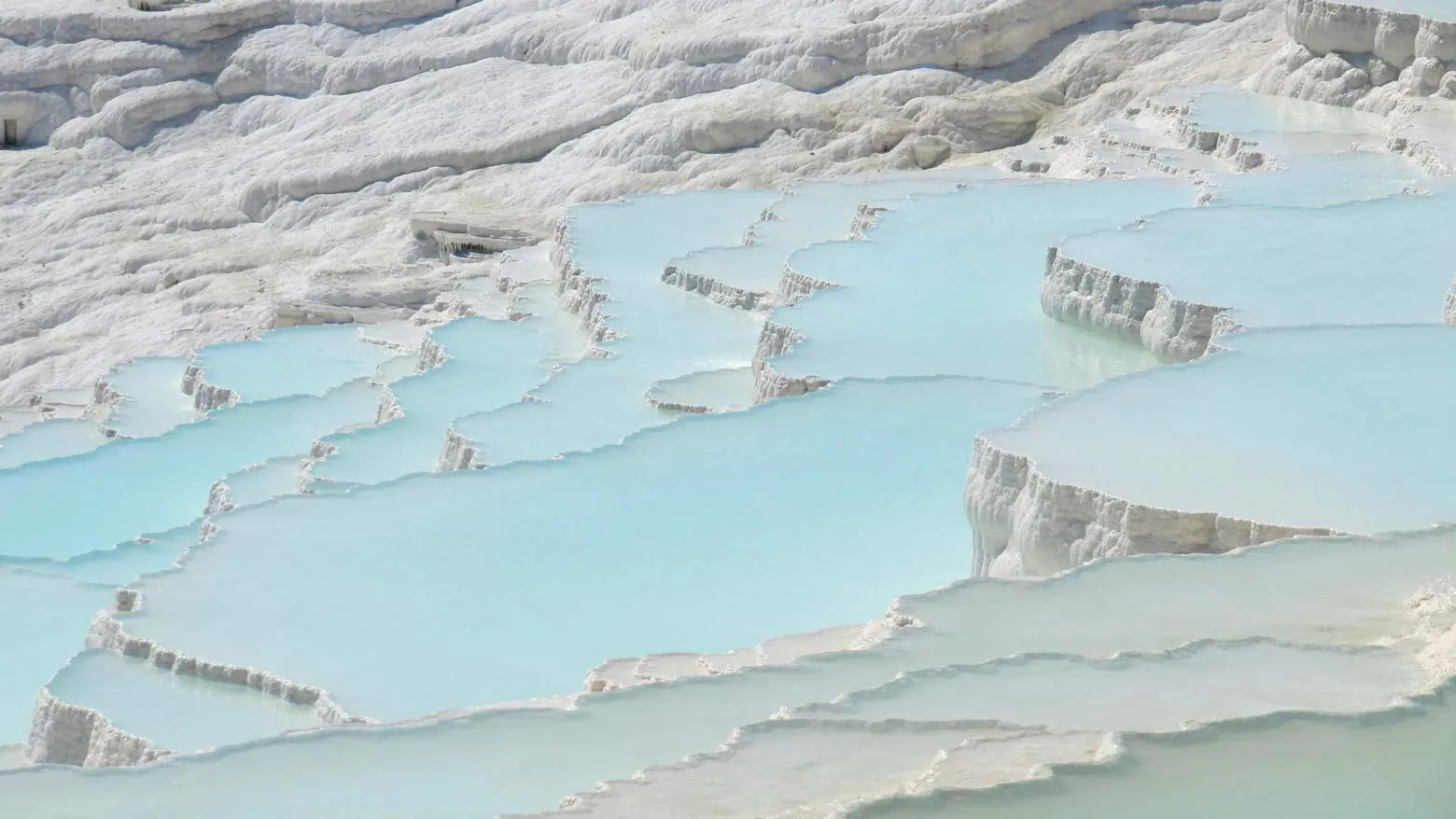
White terraces spill down a hillside beneath the ruins of Hierapolis. Their pale edges are mineral deposits left by water that still moves through the landscape.
One detail to remember
6
metres · up to
Flowing spring water leaves calcium carbonate behind.
Source / UNESCO · Hierapolis-Pamukkale02 / Landscape anatomy
Three ways to read Pamukkale.
A field guide to what you’re seeing.
Mineral-bearing waters emerge above the plain and move down the hillside.
Calcium carbonate accumulates as travertine when conditions change at the surface.
Layer upon layer builds stepped terraces along the routes taken by water.
What looks frozen
was made by flowing water.
Behind the view
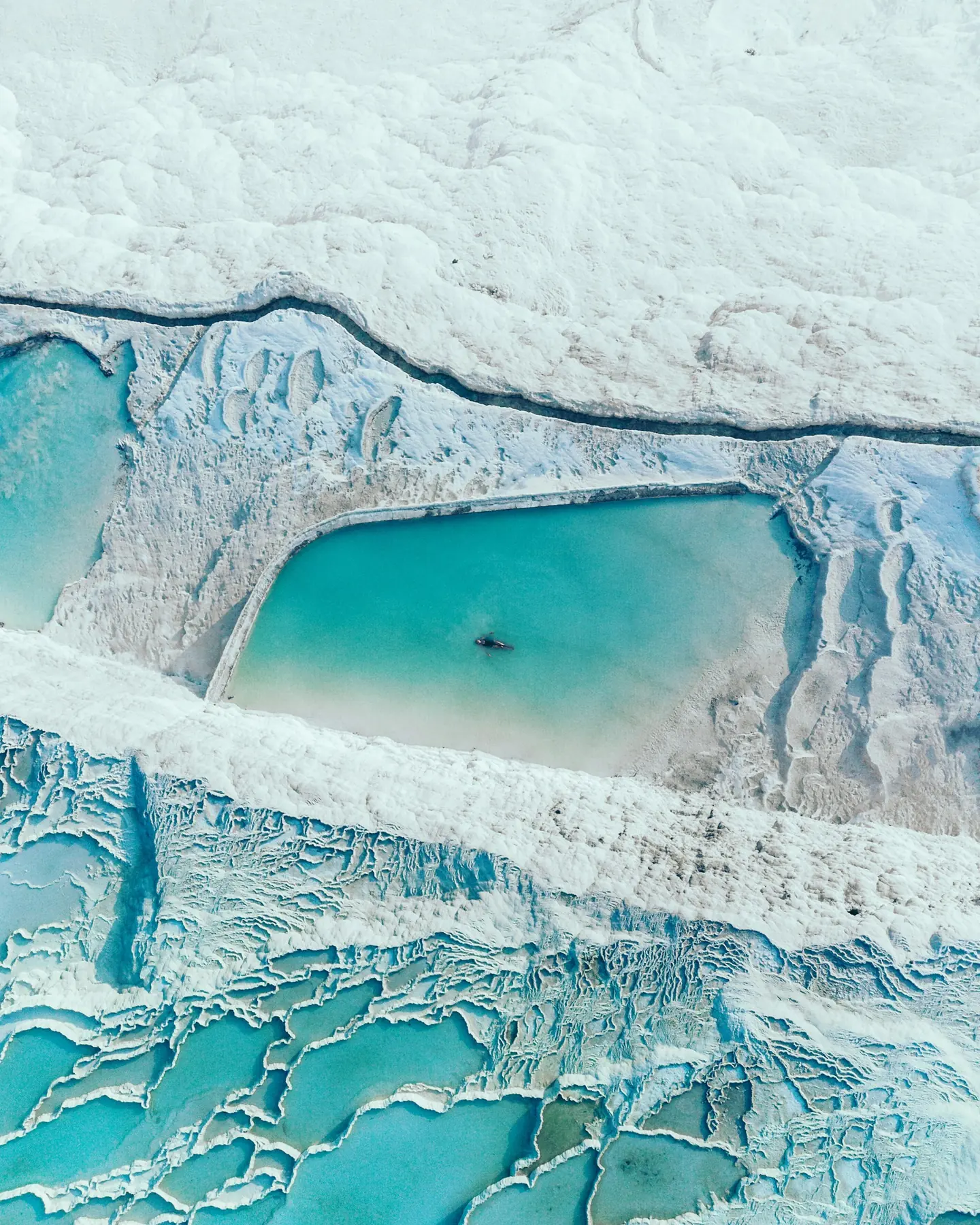
Thermal waters carrying dissolved calcium carbonate emerge above the plain. As conditions change at the surface, calcium carbonate precipitates, accumulating as travertine. Layer upon layer builds rims, steps and shallow basins. Fresh deposits give the terraces their striking white appearance. What resembles a frozen waterfall is the product of flowing water and mineral chemistry. The forms are therefore connected to the paths the springs take, rather than simply being static sculptures on a slope.
03 / The human story
Baths, temples and work.
The waters of Hierapolis.
The springs helped draw people to Hierapolis, a city founded in the Hellenistic period and later developed under Rome. Baths, temples, a theatre and a great necropolis remain above the terraces. UNESCO also notes a practical use of the thermal water: processing wool. Sacred life, bathing and work were tied to the same geological resource, making this a cultural landscape as much as a natural spectacle.
04 / Across time
The terraces’ appearance depends on flowing water, wetness and light as well as season. White mineral surfaces and blue-looking pools are parts of the same spring system.
Wet surfaces and shallow water reveal the connection between the springs and their deposits.
Earthquakes, rebuilding and conservation have all changed the setting above the terraces.
Earthquakes repeatedly changed Hierapolis; the Turkish museums authority identifies the rebuilding after AD 60 as crucial to the Roman city visible today. Below it, deposition continued along water routes. Modern conservation has also changed the scene, including removal of buildings and closure of a road across the terraces. The view combines mineral growth, ancient rebuilding and recent management.
Keep looking / Sources & photography
Hero: User-supplied photograph / User-supplied image · Resized and WebP compressed; cropped for display.
Second photograph: Rockwell branding agency / Unsplash License · Resized and WebP compressed; cropped for display.