A marble shore.
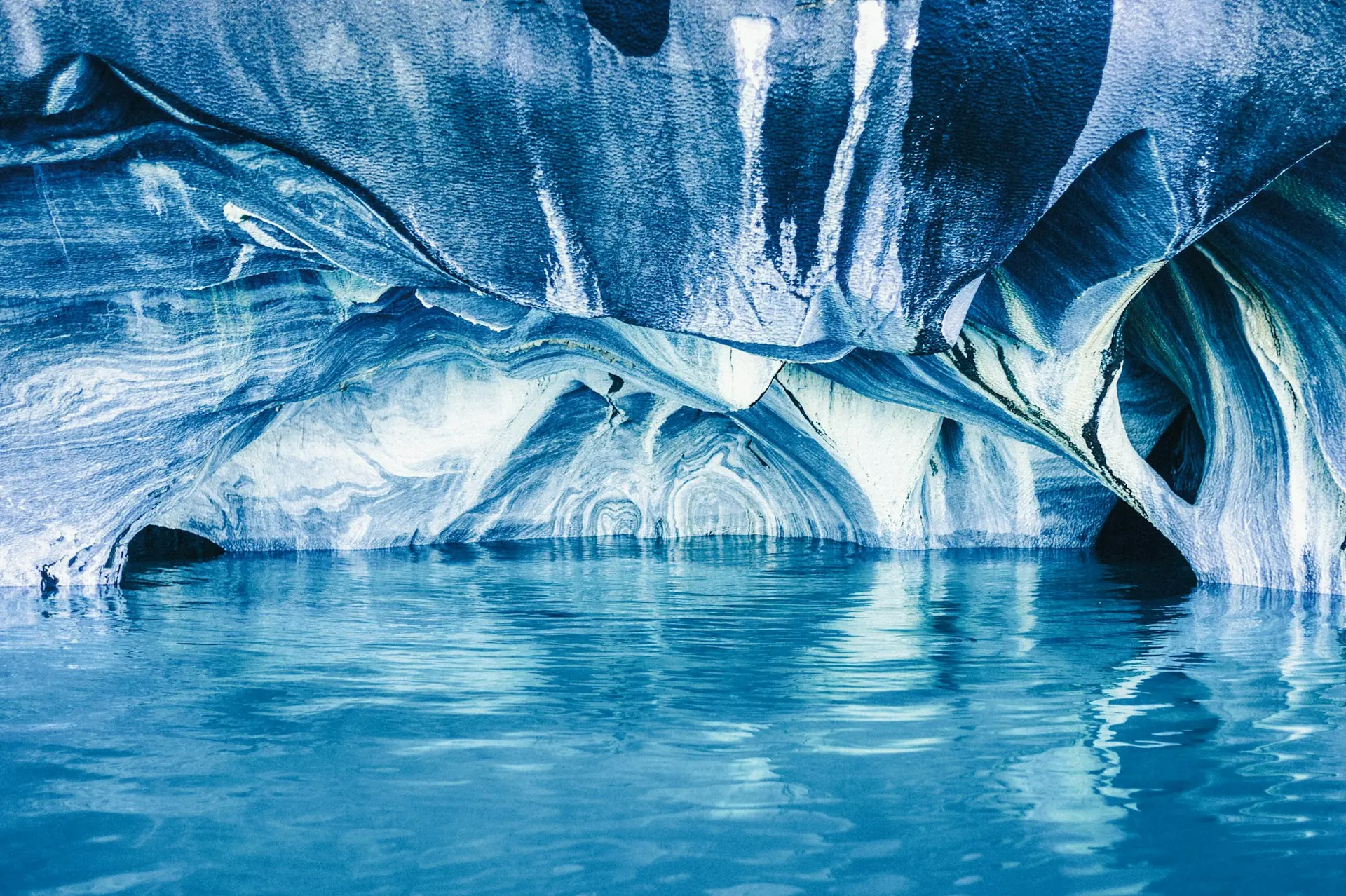
Massive marble outcrops meet the lake.
LANDSCAPE KEY Marble
01 / The landscape
A lake-lit world of curves and blue.
Pale marble folds above the turquoise water of General Carrera Lake. Reflected light moves across hollows and arches that the lake has slowly opened in stone.
One detail to remember
300
million years · approximately
The lake-carved cavities formed much later.
Source / Chile National Monuments Council · Capillas de Mármol02 / Landscape anatomy
Three ways to read Marble Caves.
A field guide to what you’re seeing.
Massive marble outcrops meet the lake.
Lake water wears and dissolves the rock into cavities.
Reflections from the water illuminate the carved interior.
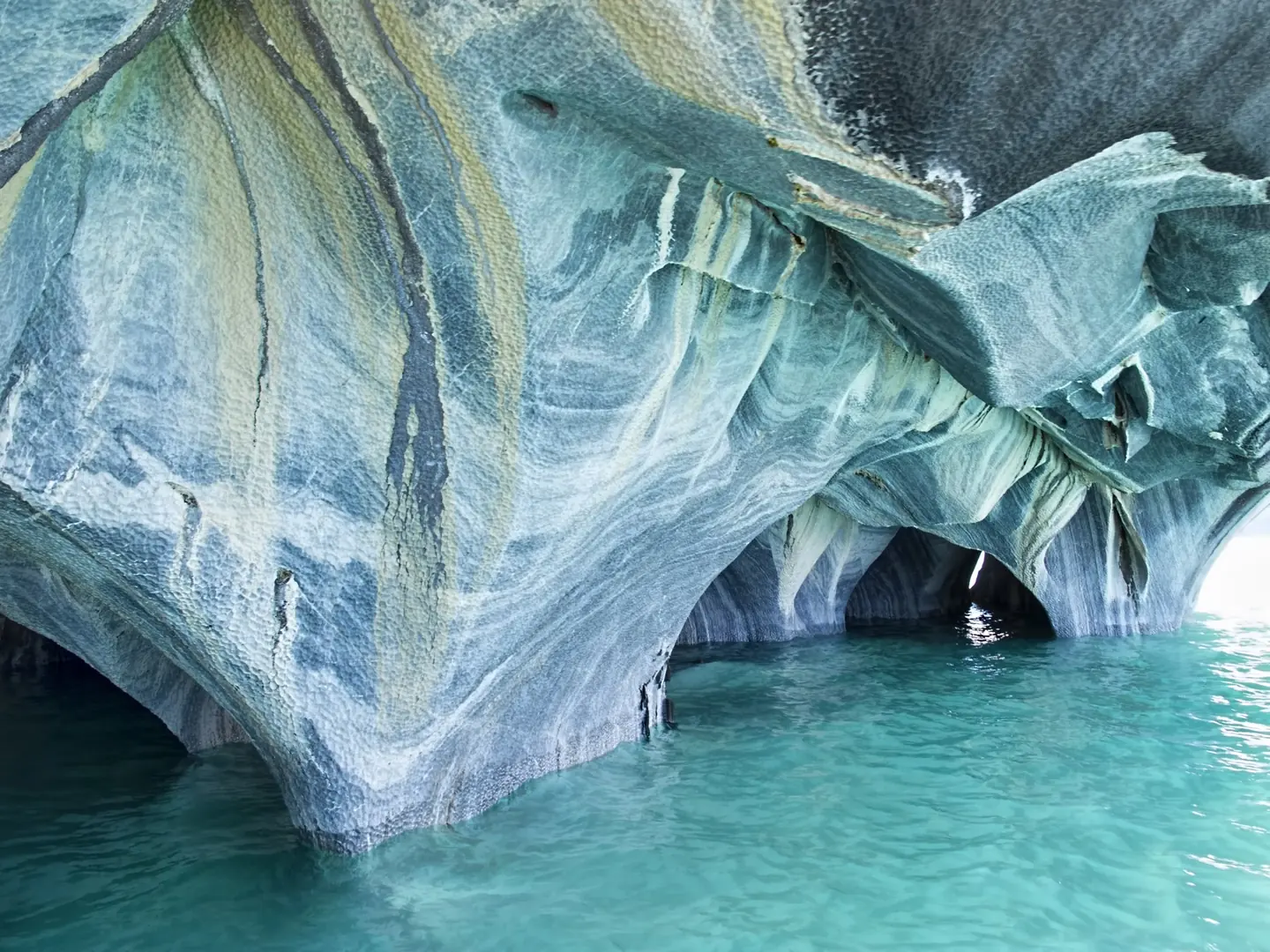
Stone holds the shape.
Water supplies the light.
Behind the view
Chile’s National Monuments Council describes marble outcrops whose colour varies with their impurities, with especially pale, relatively pure bands prominent in the formations. The lake has worked against these rocks, creating cavities and grottoes. The Chelenko geopark project explains that gradual dissolution is central to this process. The result combines the marble’s internal pattern with openings made by water: colour within the rock, and negative space created by its removal.
03 / The human story
Boats, guides and a lake.
The view begins in a community.
The formations are connected to the communities of Puerto Río Tranquilo and Puerto Eulogio Sánchez. Aysén’s official regional interpretation identifies their economic importance and their role in local identity. Boats leaving these settlements bring people close to features that can look abstract in photographs. Names such as Capilla de Mármol translate the shapes into familiar architecture, giving an eroded lakeshore a human vocabulary of chambers, chapels and stone walls.
04 / Across time
Water level alters the exposed openings. Sunlight and moving reflections change the appearance of the pale marble, so the same chamber can look different within minutes.
Lake level changes the relationship between the caverns and their reflections.
Light and surface ripples continually redraw the interior.
The Chelenko geopark project describes the cavities as the product of dissolution over thousands of years. That process continues: the shapes have no final, completed state. On a much shorter timescale, water level changes how much of each opening is exposed, while reflected light moves across the interior. The stone’s long transformation and the water’s immediate motion are visible together.
Keep looking / Sources & photography
Hero: Timothy Cohen / Unsplash License · Resized and WebP compressed; cropped for display.
Second photograph: Dan Lundberg / CC BY-SA 2.0 · Resized and WebP compressed; cropped for display.